ONE MARKET. MULTIPLE INSTITUTIONAL APPLICATIONS.
LIX is designed to give institutions a common benchmark and market structure for measuring, transferring and building around life expectancy risk.
Powering decisions. Managing risk. Creating value.
LIX is not a single-purpose hedging product. The same benchmark and market infrastructure can support different institutional objectives: risk management, market-view expression, index-linked product development, clearing and downstream retirement applications.
The common foundation is the LIX Curve. Institutions can enter through different use cases while still operating against the same reference framework, market structure and data layer.
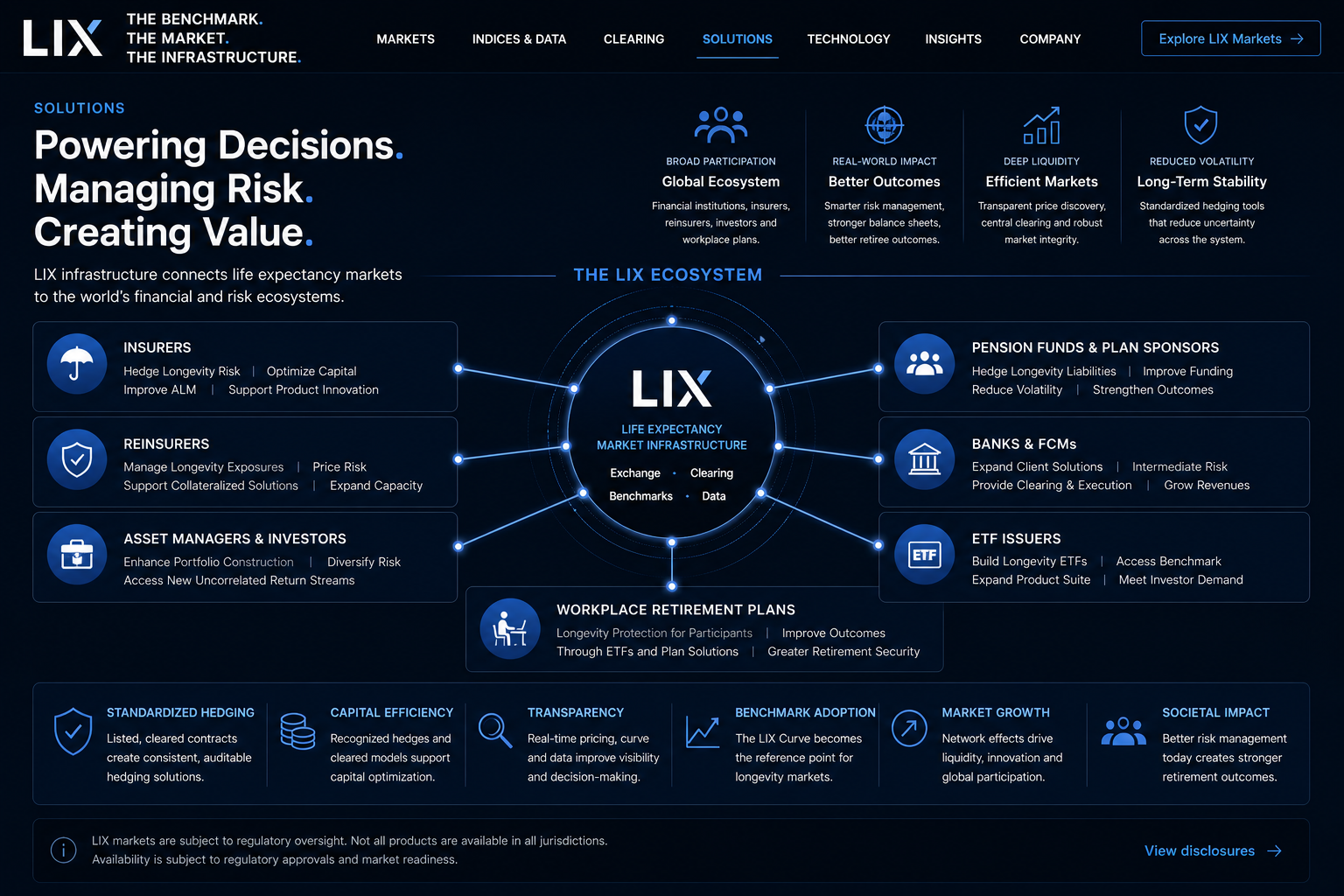
Different institutions enter the market for different reasons.
Insurers and reinsurers may begin with liability risk. Asset managers may begin with a market view. Banks and FCMs may provide intermediation and access. Product manufacturers may use the benchmark as an input to new financial products. The infrastructure is common; the application changes.
Insurers & Reinsurers
Hedging, liability risk transfer and balance-sheet applications.
Asset Managers
Relative-value, macro and portfolio applications.
Banks & FCMs
Execution, intermediation, market making and clearing access.
Retirement Ecosystem
Benchmark-linked products and distribution applications.
Start with the exposure. Map it to the curve.
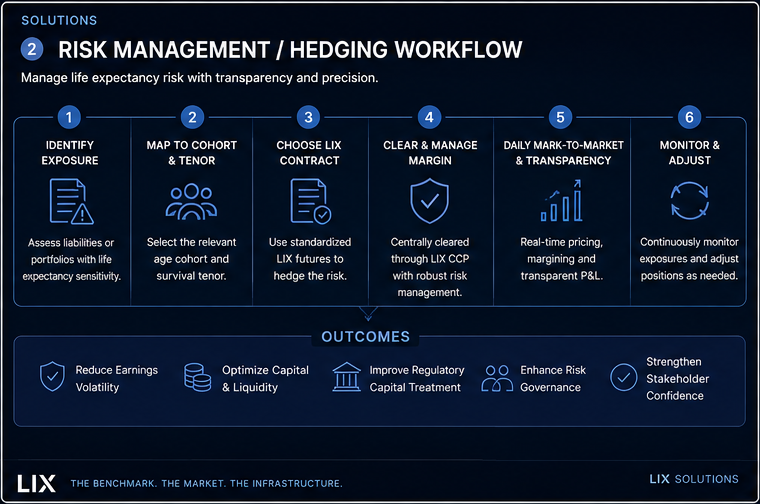
Institutional risk management begins by identifying where life expectancy sensitivity exists in a liability or portfolio. LIX then provides a standardized way to map that exposure to an age cohort and survival tenor rather than treating the risk as one undifferentiated long-duration assumption.
The workflow is designed to move from exposure → cohort and tenor → contract selection → clearing and margin → daily monitoring. The objective is to make the hedge measurable, repeatable and governed.
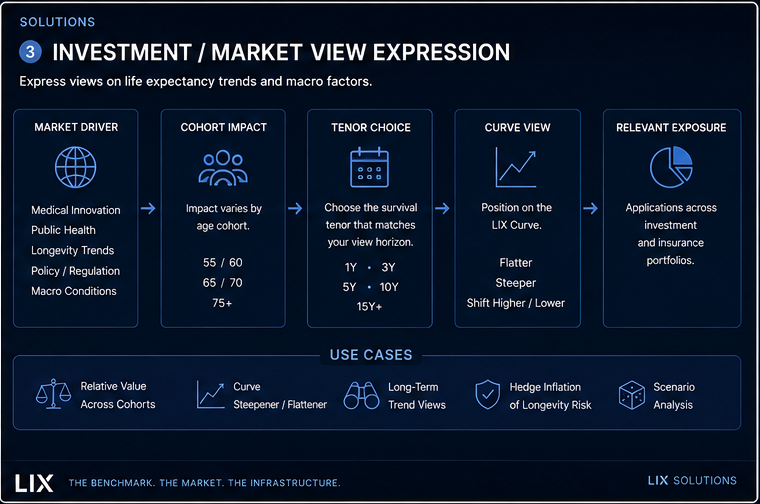
A view on life expectancy can be specific.
Medical innovation, public health, demographics and policy do not affect every age group or every horizon equally. A standardized curve lets an investor express a view on the portion of the market that matches the thesis.
That can mean relative value across cohorts, a steeper or flatter curve, a long-term trend view, or a scenario tied to a particular market driver. The point is not simply to “trade life expectancy.” It is to choose which cohort, which horizon and which curve exposure.
The benchmark can become infrastructure for other products.
Once a transparent benchmark exists, it can support applications beyond the futures market itself. Asset managers, insurers, wealth platforms and other product manufacturers can reference a common methodology instead of building incompatible assumptions from scratch.
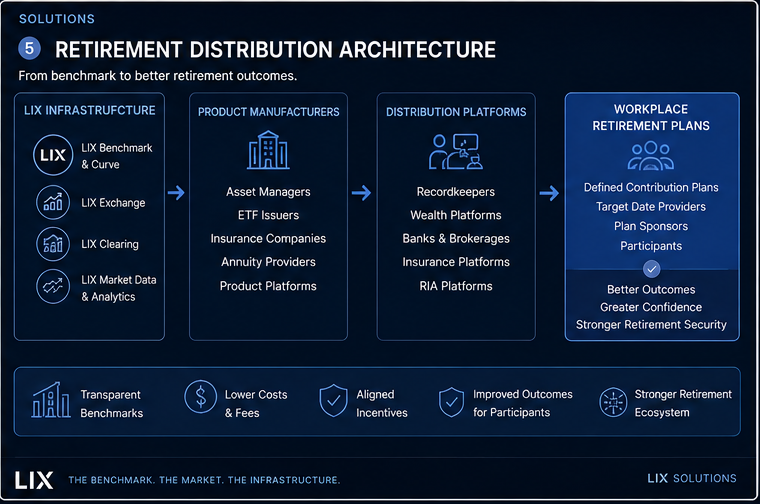
The architecture is benchmark → license and data → product construction → institutional distribution. That is how a reference point can expand into an ecosystem.
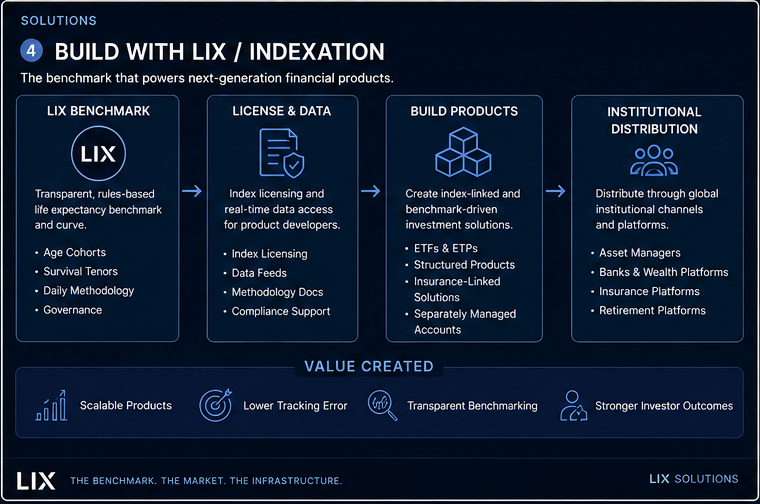
From market infrastructure to downstream applications.
LIX infrastructure is upstream: benchmark, exchange, clearing and data. Downstream institutions can use those reference points in products and platforms that serve retirement and wealth markets.
The important distinction is that LIX does not need to manufacture every downstream product. The market can become a pricing, hedging and benchmark rail used by product manufacturers and distribution platforms.