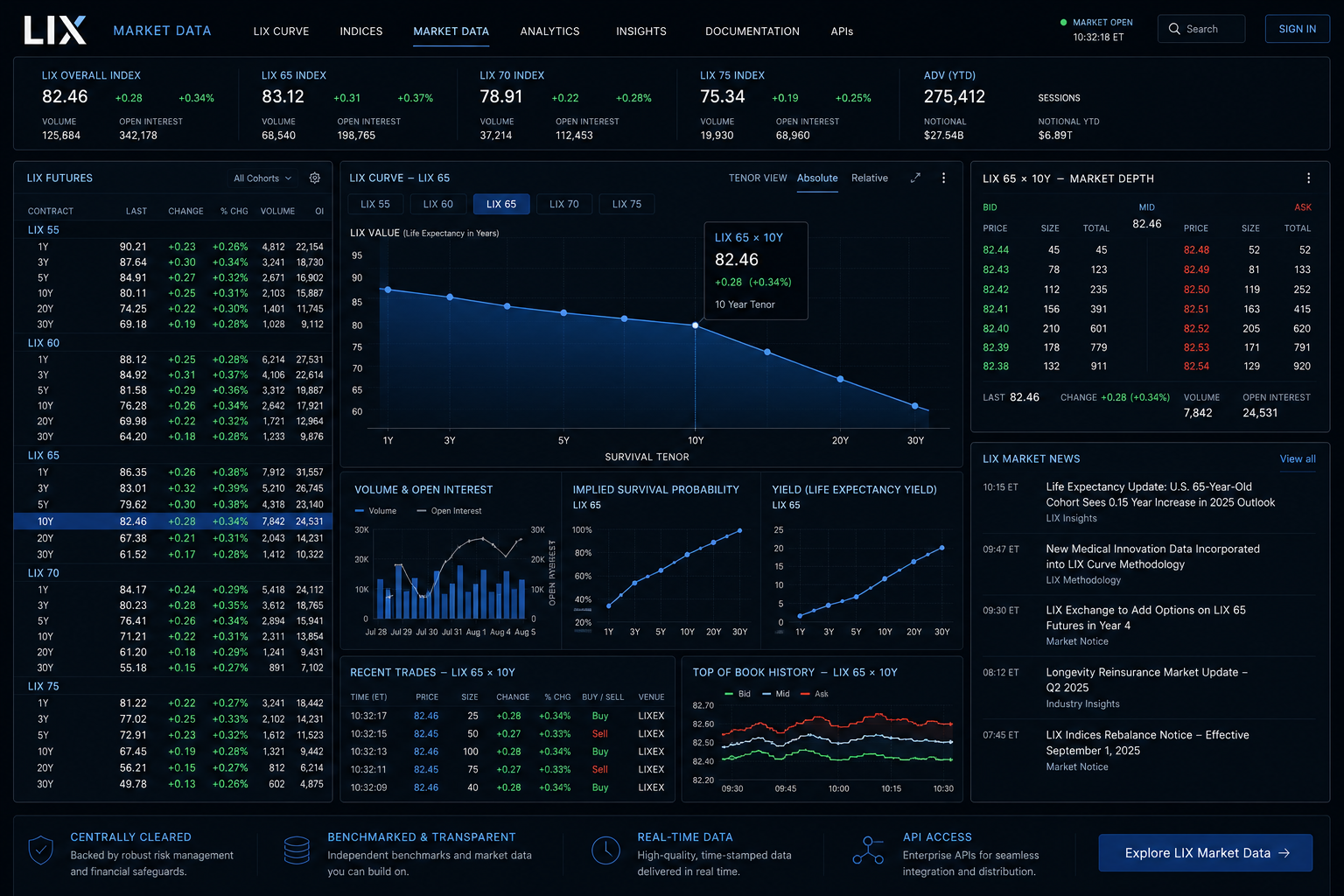
LIFE EXPECTANCY ACROSS AGE AND TIME.
LIX organizes the market around standardized age cohorts and survival tenors so institutions can express, compare and transfer risk on a common curve.
The contract grid is the market.
A single “life expectancy price” would hide the structure institutions actually need. A 55-year-old cohort and a 75-year-old cohort are exposed to different information. A one-year horizon and a twenty-year horizon reflect different risks.
LIX therefore organizes contracts as age cohort × survival tenor. That creates a matrix of standardized exposures and, over time, a market-implied term structure.
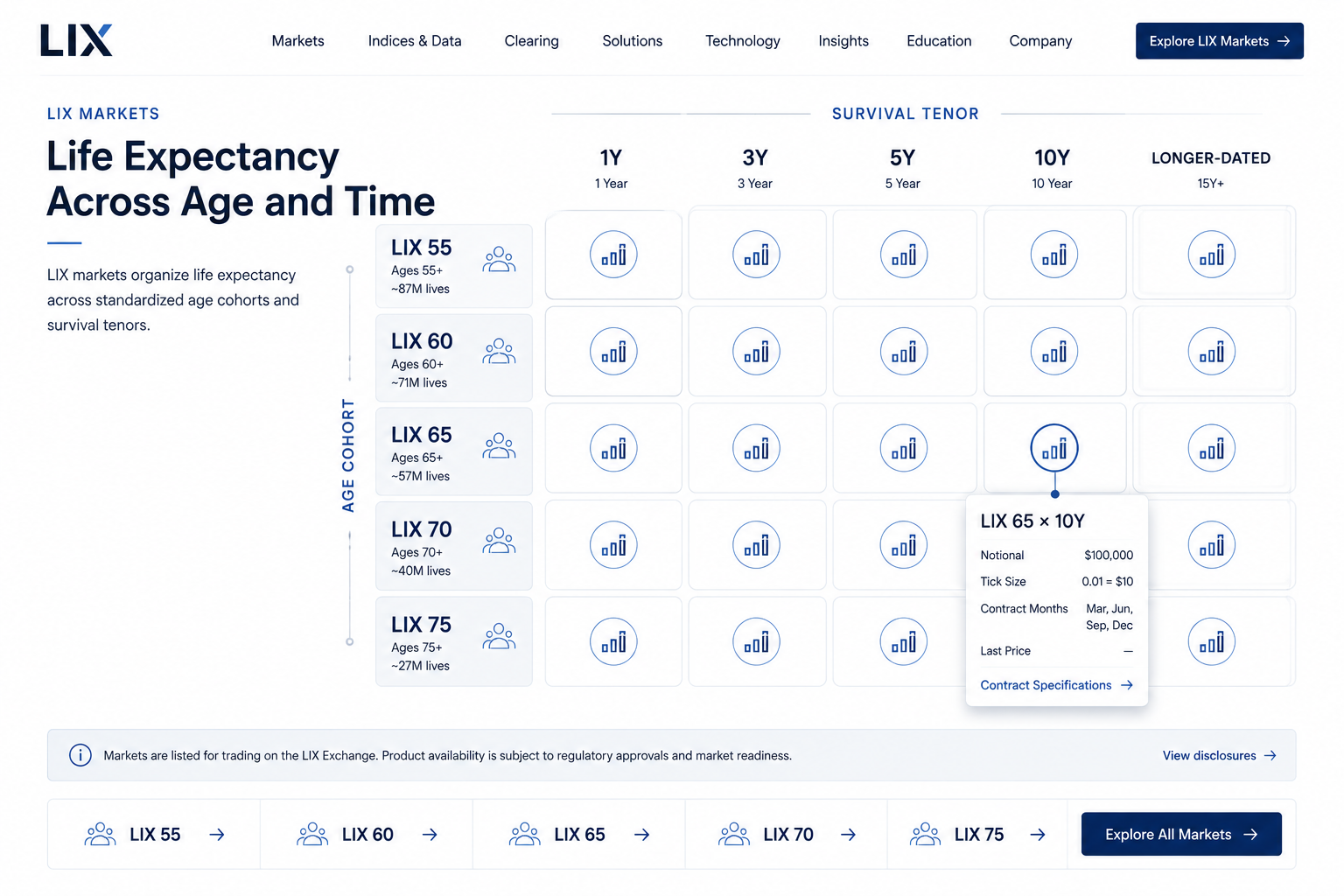
Standardized terms make different trades comparable.
The governing design uses a $100,000 notional and a 0.01 price tick equal to $10, with quarterly March, June, September and December listings. The pricing convention is designed around Price = 100 − LIX Yield.
Standardization is what lets a market accumulate liquidity and data across participants rather than fragmenting every risk transfer into a bespoke bilateral negotiation.
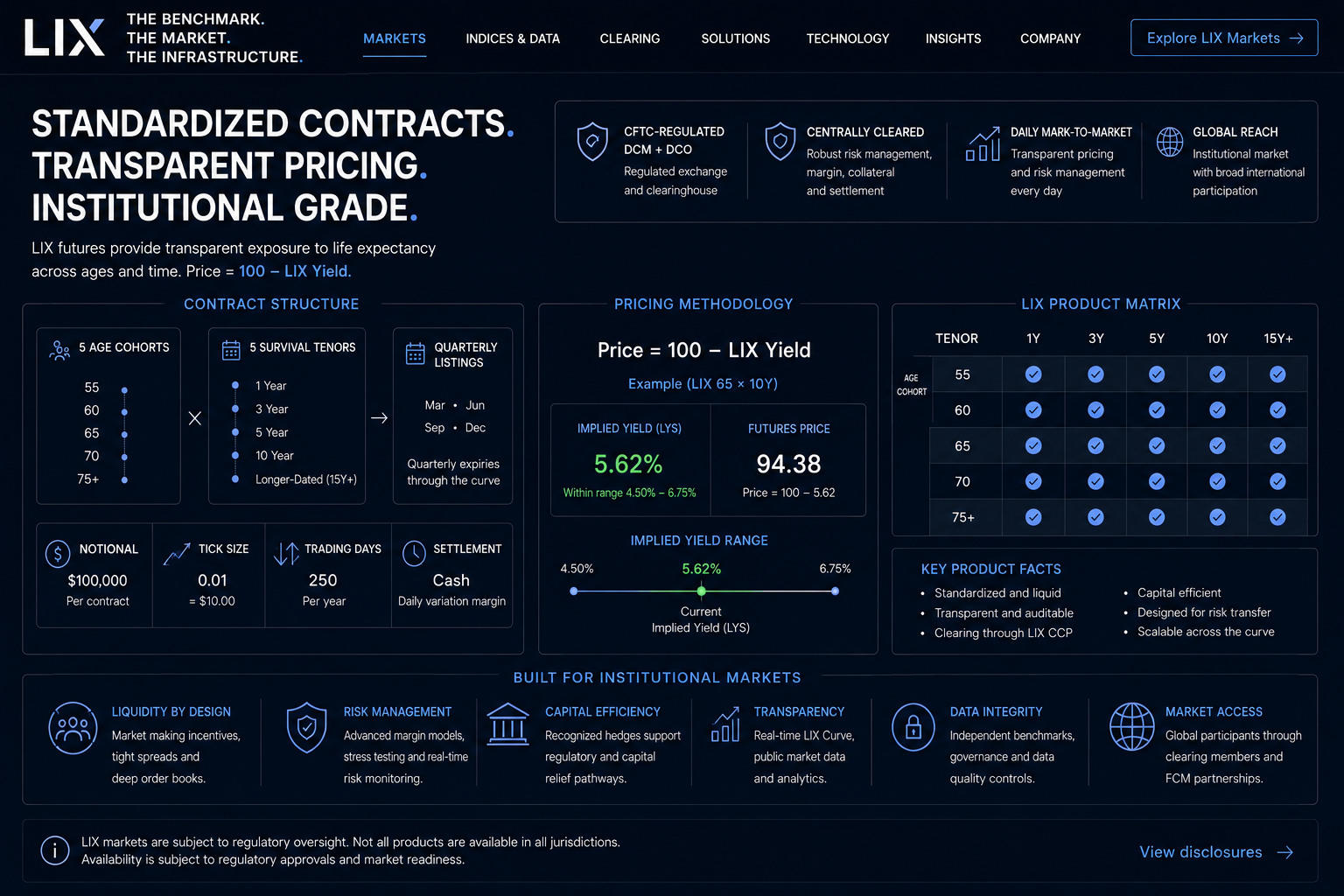
A functioning market turns transactions into information.
The market-data layer is the by-product of transparent trading: prices, yields, curves, spreads and historical observations that can then feed risk systems, research, benchmarks and product design.