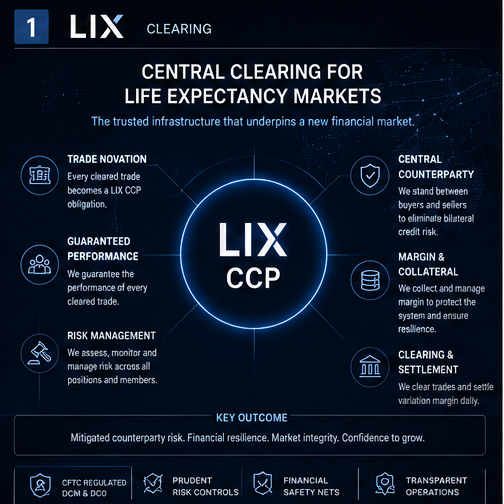
CENTRAL CLEARING FOR A NEW MARKET.
LIX Clearing is designed to put counterparty risk management, margin, collateral, stress testing and default management at the center of the market architecture.
Turn bilateral exposure into a standardized clearing relationship.
In a centrally cleared market, the clearinghouse stands between buyers and sellers and applies a common risk framework across participants. That structure is intended to reduce bilateral counterparty complexity and create consistent operational and financial safeguards.
For LIX, clearing is not a back-office feature. It is part of the product proposition: the market is being designed around transparent valuation, margining, settlement and risk management from the beginning.
Collateralize the risk. Recalculate as the market moves.
A clearing framework needs to translate market exposure into financial resources. Initial margin is designed to cover potential future exposure; variation margin responds to daily changes in market value; eligible collateral provides the resources backing those obligations.
The methodology must be transparent enough for members to understand the drivers of margin while remaining conservative enough to protect the clearing system under stress.
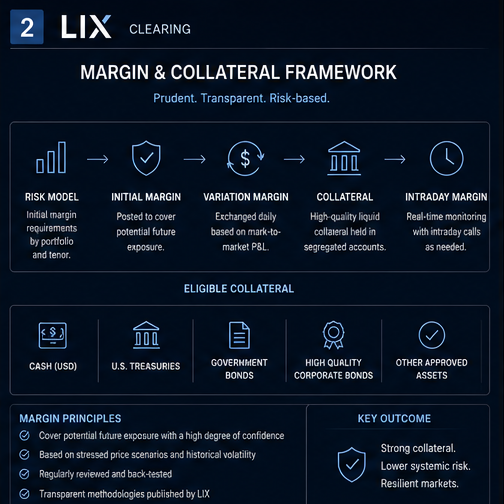
The higher-level workflow above shows how margin and collateral fit into clearing. The detailed framework below expands the same topic into risk factors, collateral categories, stress treatment and the operating margin process.
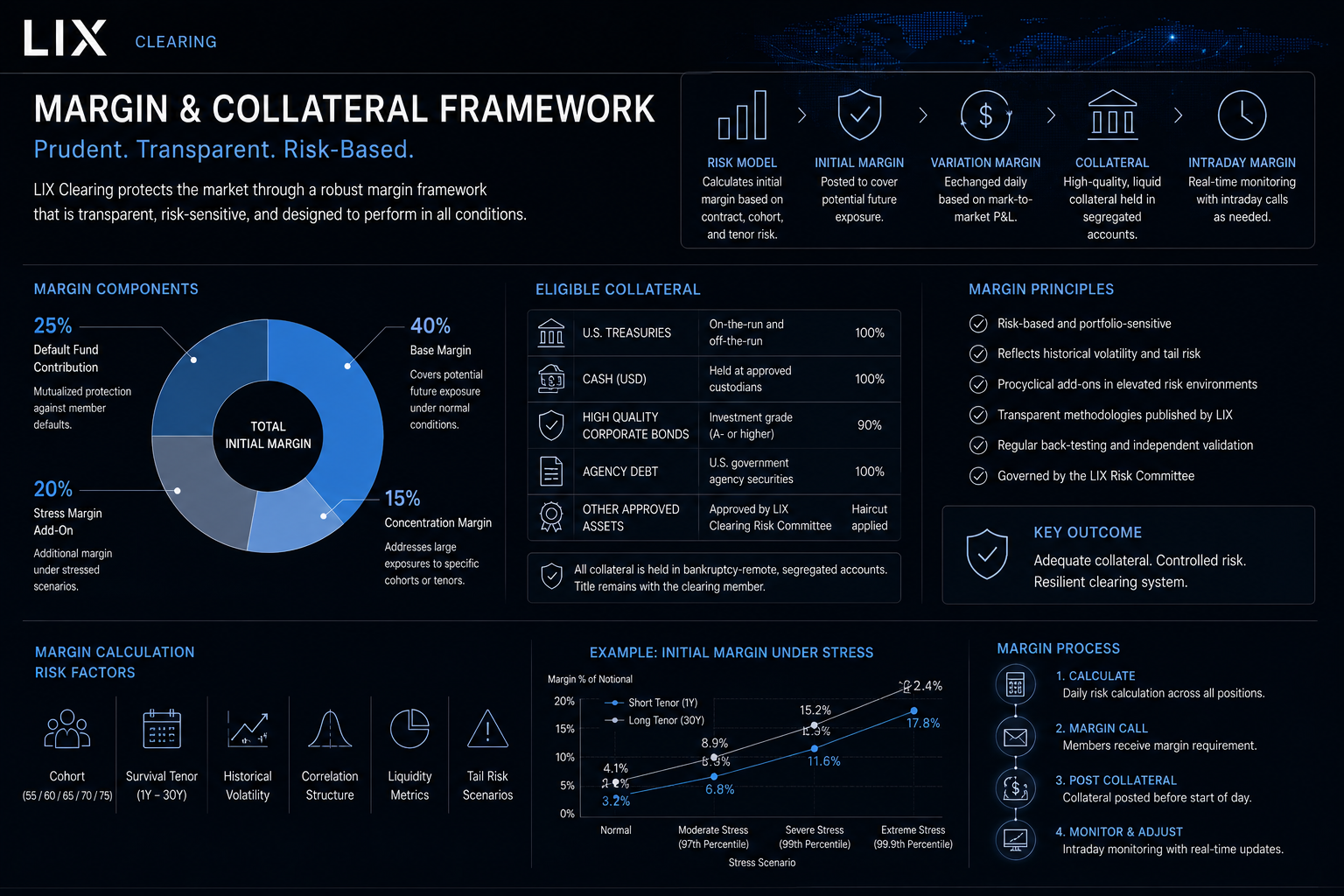
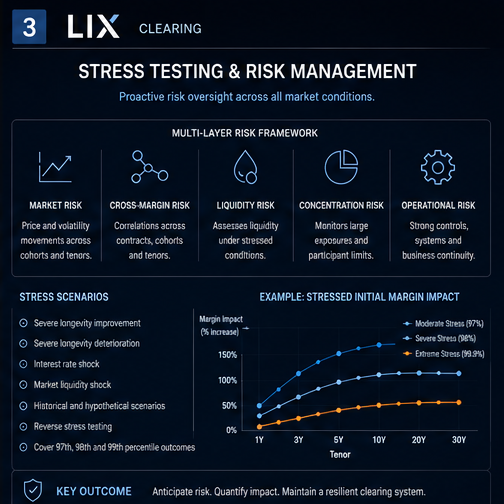
Normal markets are not the test. Extreme markets are.
Stress testing is designed to ask what happens when assumptions move sharply, liquidity deteriorates, concentrations build or multiple risks occur together. The objective is to quantify exposures before they become losses the system cannot absorb.
LIX’s clearing design contemplates market risk, cross-margin relationships, liquidity risk, concentration risk and operational risk, supported by historical, hypothetical and reverse-stress scenarios.
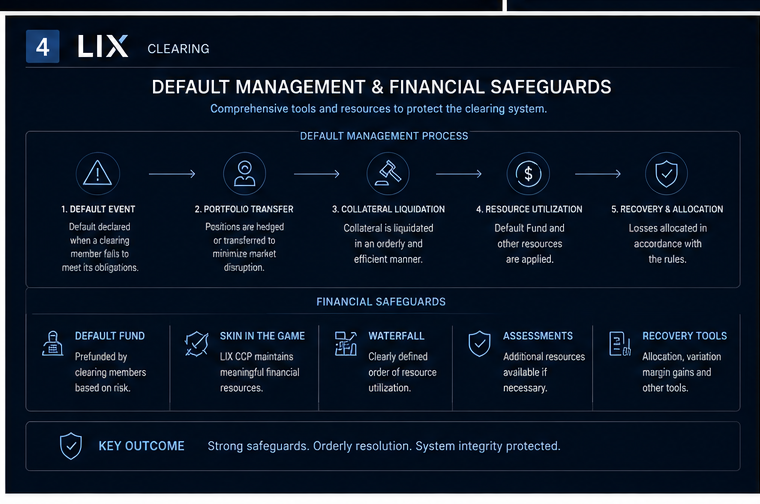
Plan the resolution process before a default occurs.
A clearinghouse must have an orderly process for managing a participant failure. That means rules for hedging or transferring positions, liquidating collateral, applying available resources and allocating losses in a defined sequence.
The goal is not to eliminate risk. It is to make the response to risk pre-defined, governed and transparent, with a financial-resource framework that protects the integrity of the broader market.
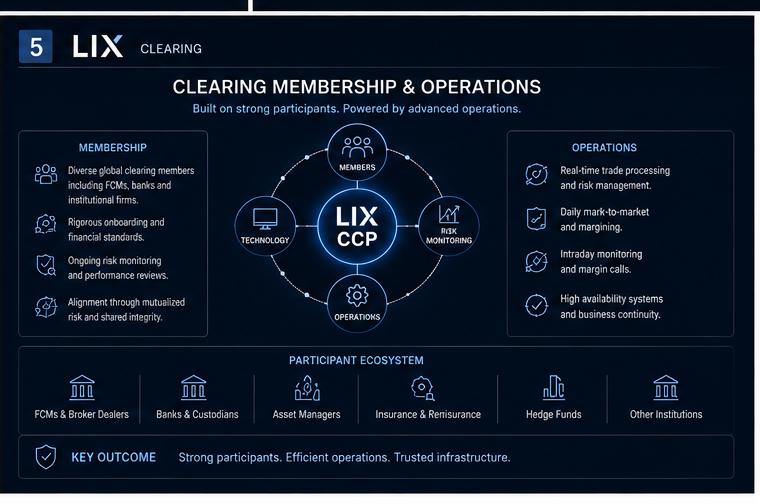
Clearing works only when strong participants and strong operations meet.
Membership standards, onboarding, risk monitoring and operational readiness are part of the clearing risk framework. The system must also support reliable trade processing, daily mark-to-market, intraday monitoring and business continuity.
This is where membership, technology, risk and operations converge. A resilient clearinghouse is an operating institution, not simply a risk model.